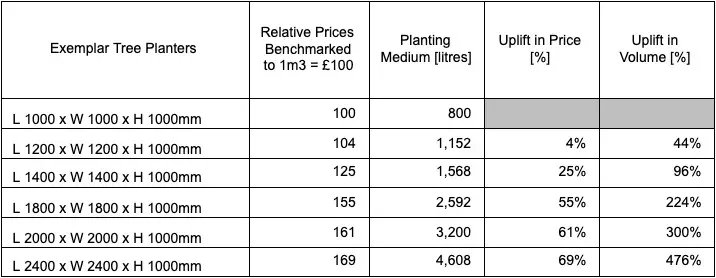
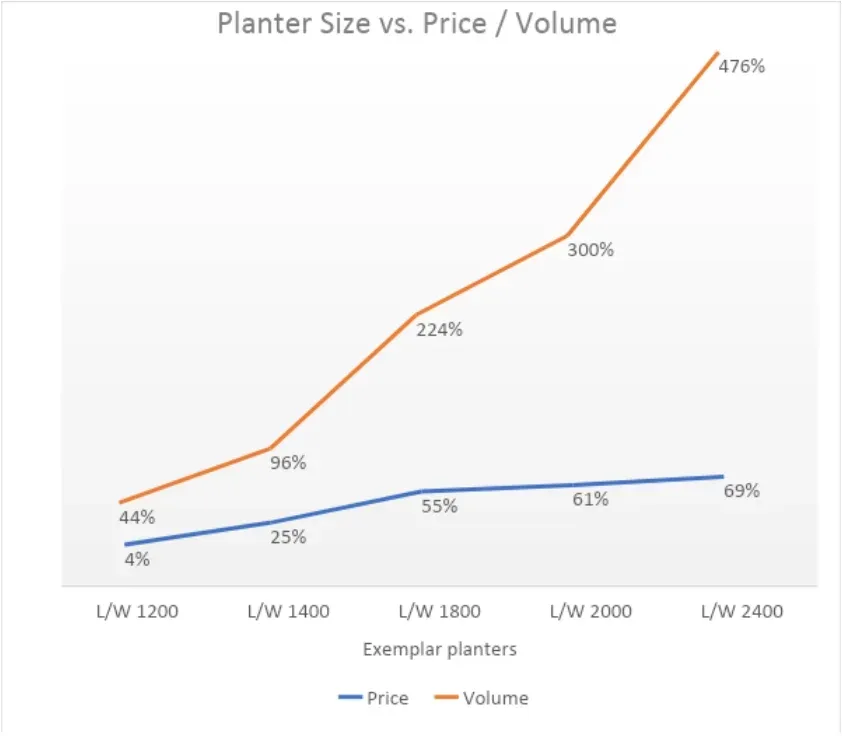
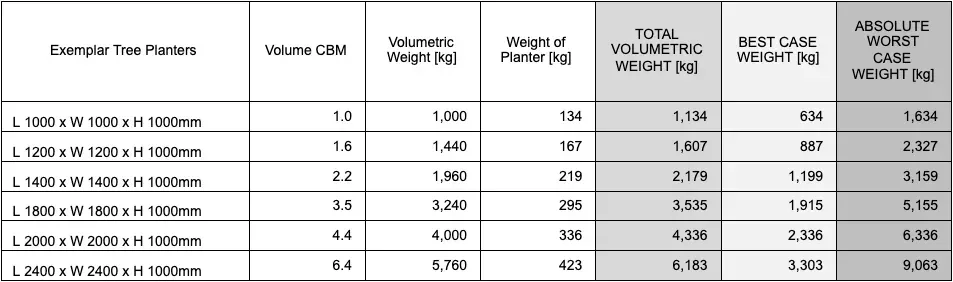
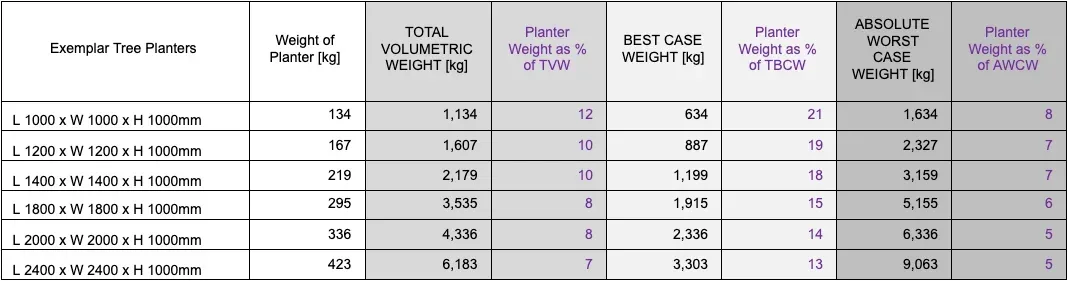
In addition to size vs. price / volume, there is another asymmetric price vs. performance relationship with metal tree planters – this time relating to metal thickness. For products with no [or very little] manufacturing inputs, the relationship is absolutely clear – as: - Material costs scale in a linear fashion – near enough. Therefore, if you double the thickness of a steel or aluminum sheet, you pay roughly double for the raw metal.
- However, while the material cost is linear, or near-linear, the structural benefit grows exponentially. For example, a 2x increase in thickness results in an 8x increase in strength, bending stiffness and resistance to buckling.
So, for a product with low manufacturing value-added [like planted border edging, for example] scaling up thickness delivers unarguably disproportionate performance benefits. However, for fabricated products, like tree planters, the relationship is less obvious – as: - The manufacturing costs are often a more significant part of the total cost than the material cost.
- And these manufacturing costs do suffer from a non-linear increase as metal thickness increases.
Specifically, the cost to cut, bend, weld and make fair the [say] tree planter does significantly increase with sheet thickness – for example: - Laser Cutting: Thicker metals require higher laser power and significantly slower cutting speeds to pierce the material, driving up machine operation costs.
- Bending [Press Brake]: Forming thick sheets requires much higher tonnage and specialised, heavy-duty tooling, which increases cycle times and labour costs.
- Welding: Thick metals often require multiple passes, weld bevelling, and additional heat input, increasing both consumables cost and labour hours.
So tree planters made from thicker metal do deliver disproportionately enhanced performance, and that trade off may well be worth considering; but that trade off is not necessarily an absolutely compelling case in all circumstances, once both material costs – and manufacturing costs – are factored in. There are also additional complicating factors, such as weight; and, at some point, increasing thickness delivers levels of performance which are frankly not necessary, so returns become either diminishing, or positively negative. The precise science and maths behind this discussion is complex, and beyond the scope of this article – so, for project-specific guidance, please just contact us. However, hopefully the insights below from IOTA’s experience will provide helpful general guidance. Note: The material assumed is steel – for reasons discussed later, aluminium is rarely used for tree planters. 2.0mm steel – acceptable at the marginWhen budgets are constrained, 2.0mm steel is perfectly acceptable for 1m3 tree planters. At this scale, the lateral soil pressure is manageable, and 2.0mm is sufficient to prevent bowing, so long as the top rims and bases are folded internally, and there is some internal cross-bracing. 3.0mm steel – the “sweet spot”The vast majority of mature tree planter installations use planters of moderate scale [say, from W / L 1220 x H 1000mm up to W / L 2000 x H 1000mm], and 3.0mm is the industry standard for tree planters of this scale. It provides the physical robustness needed to resist soil expansion and frost heave without demanding expensive welding or becoming prohibitively heavy. And there is a clear asymmetric scale benefit. Scaling up from 2.0mm to 3.0mm only increases the material weight and cost by 50%, and the impact on manufacturing costs is marginal. Whereas, because stiffness scales exponentially, the side panels of the planter become 337% stiffer. | 4.0mm – diminishing returns up to W / L 2000 x H 1000mm4.0mm plate makes the planter 8 times stiffer than 2.0mm, but the total manufacturing cost more than doubles, as manufacturing costs start to rise in a non-linear fashion. And the planters are starting to get seriously heavy, which sharply drives up logistics, delivery, and on-site installation labour costs. For tree planters of moderate scale, as above, the only real justification for 4.0mm steel is if “belts and braces” performance is required. In all other cases, the more cost-effective approach is to stick with 3.0mm, and to beef up the internal support ribs, cross bracing, and corner bracing. 4.0mm – XL tree planters or extreme longevityFor extra-large tree planters [say, W / L > 2000mm but < 2400mm], the additional cost of 4.0mm steel can be more readily justified. The final specification decision is down to the ambition of the tree planting. So, if the planting ambition is relatively modest, then generally it’s acceptable to stick with 3.0mm – if it is very ambitious, then one would specify 4.0mm. Also, if the scheme objectives include extreme longevity, then 4.0mm may also be justified. If specifying Corten steel, for example, a 3.0mm thickness pretty much guarantees a 25 year lifespan. Scaling up to 4.0mm should extend this lifespan to beyond 40 years. Corten Steel – The Facts and The Unique Benefits. 4.0mm or 5.0mm – the only option for very large, rimless planters5.0mm is really reserved for very large, ‘rimless’ planters, and 4.0mm may still often suffice. In all sheet metal planters, the rigidity of the side panels is substantially a consequence of creating both a rim, and a footer at top/bottom of each sheet used to create the sides. Folding the top/bottom of the sheet inwards dramatically increases the steel’s structural rigidity, and prevents the metal from twisting or warping under load. Most often, with planters, the desired aesthetic is to create a definite rim profile at the top, to act as a ‘frame’ to the planting, and to increase perceived value. However the top/bottom edges can also be simply folded back onto themselves – a process known as hemming or flanging. Where a completely ‘rimless’ aesthetic is desired, then it really has to be either 4.0mm or 5.0mm, depending on the specific scale and geometry of the scheme’s arrangement. Where there are curves – which are inherently more stable forms than straight lines – then 4.0mm is still acceptable: City of London Corporation, Cursitor Street. > 5.0mm – to deliver structural / architectural objectivesFor anything over 5.0mm thickness, there generally needs to be some kind of additional, structural cost justification. Planters can be ‘more than just planters’, and they can form part of larger, structural designs that are delivering functionality additional to the horticultural – whether that be edge protection at height, earthwork barriers, or other design integrations with the structural or architectural fabric of a building. In such situations, the thickness of the metal needs to be what is necessary to meet the totality of functional objectives, of which the strict ‘tree planting’ element may be secondary. An extreme example of such a scheme is: The Glebe, Chelsea, London SW3. |